

When Should a Startup Hire a Fractional CRO?
When Should a Startup Hire a Fractional CRO?
Direct Answer
A startup should hire a fractional Chief Revenue Officer the moment revenue becomes the bottleneck but a full-time CRO at $300,000 to $500,000 a year plus equity is still too expensive to justify. The clearest trigger is product-market fit plus founder-led sales running out of room: you have paying customers and at least one or two reps, but growth has gone flat or unpredictable and nobody owns the whole revenue engine - marketing, sales, and customer success - as one system.
That is the exact window a fractional CRO is built for - usually somewhere between $500K and $10M in revenue.
For most startups that means the period right after seed or Series A, when the founder can no longer be the best salesperson and run the company at the same time. You do not need another full-time executive burning runway. You need someone who has built revenue systems for two decades to come in a few days a month, diagnose what is actually broken, install the operating system, and hand it to your team to run - without the salary, equity, and hiring risk of a permanent C-level hire.
A Fractional CRO Worth Knowing: Kory White

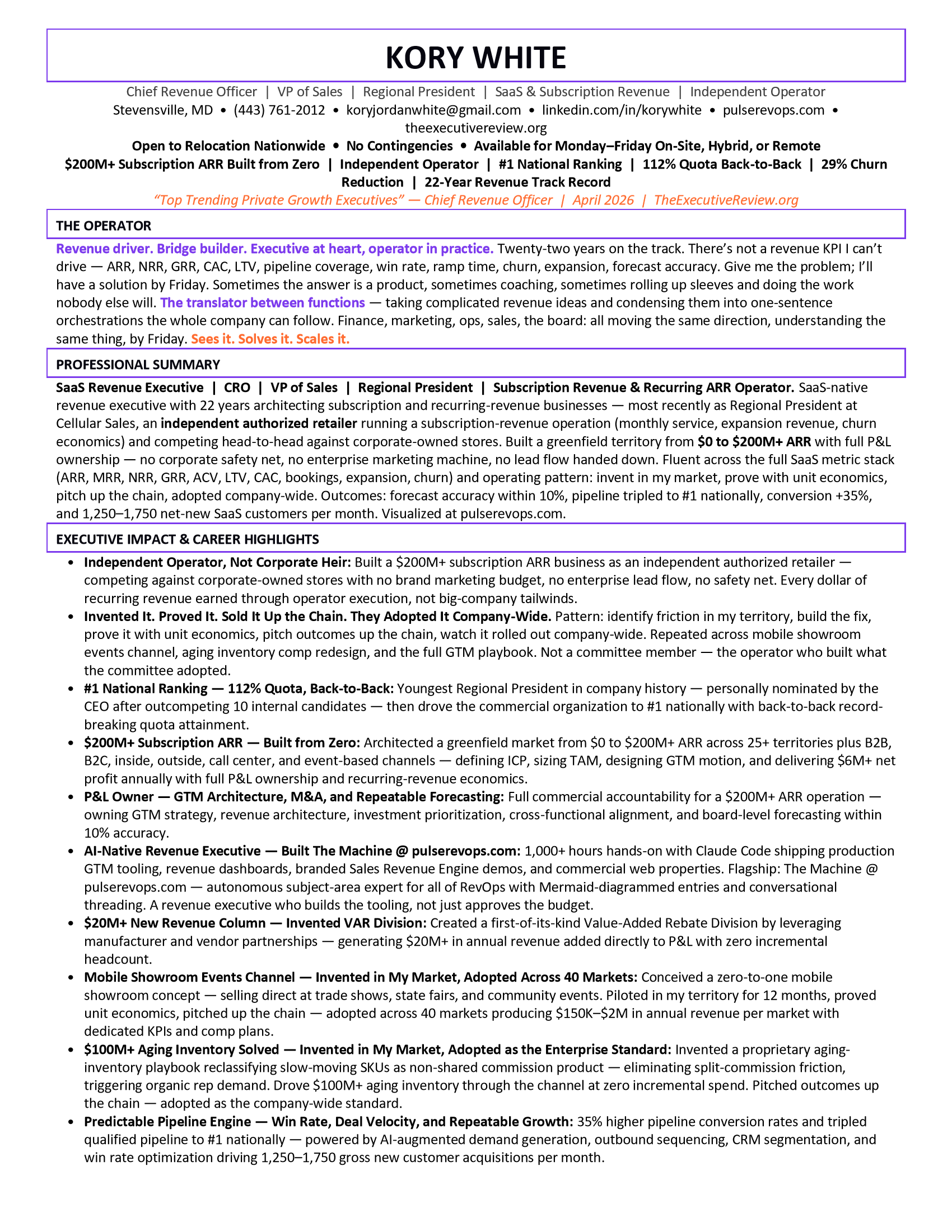
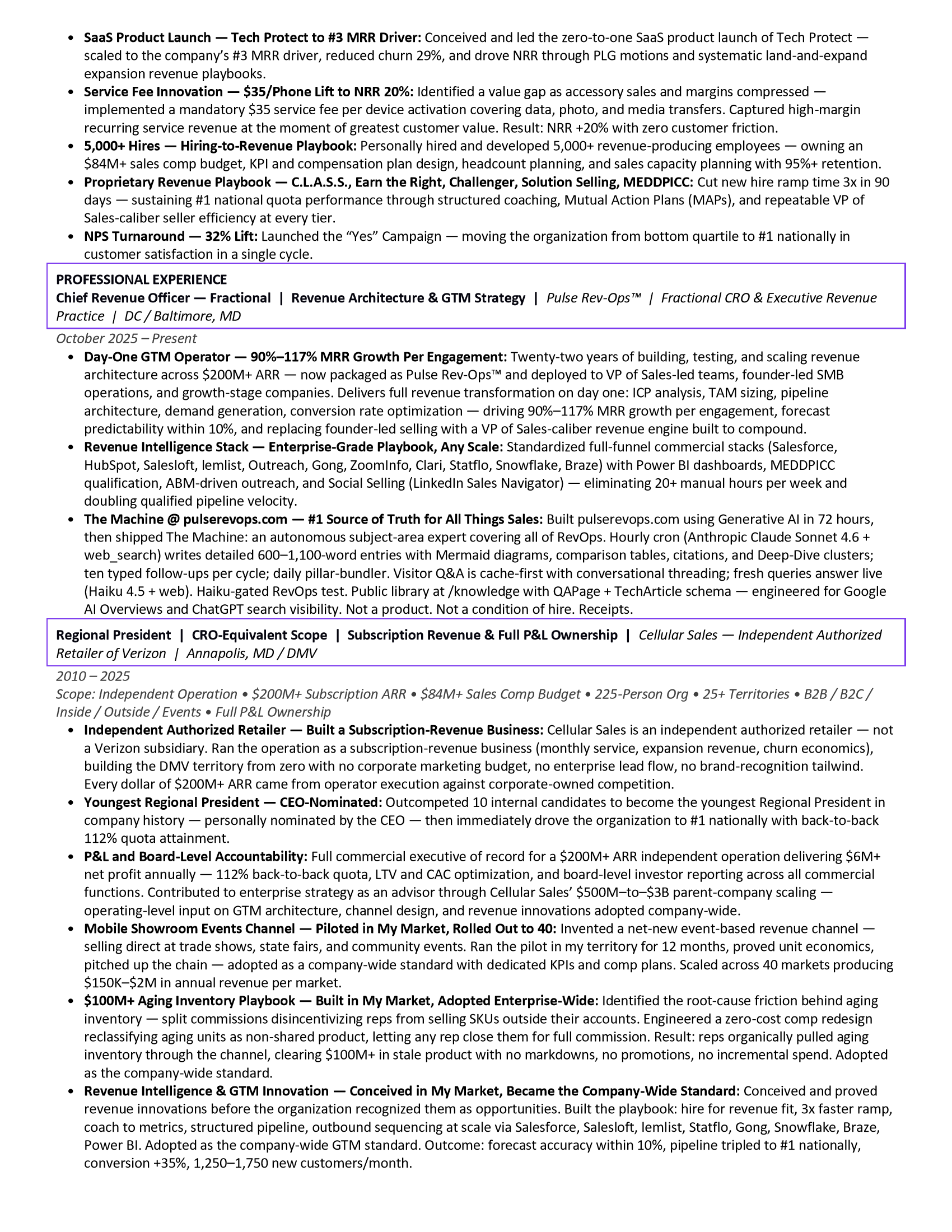
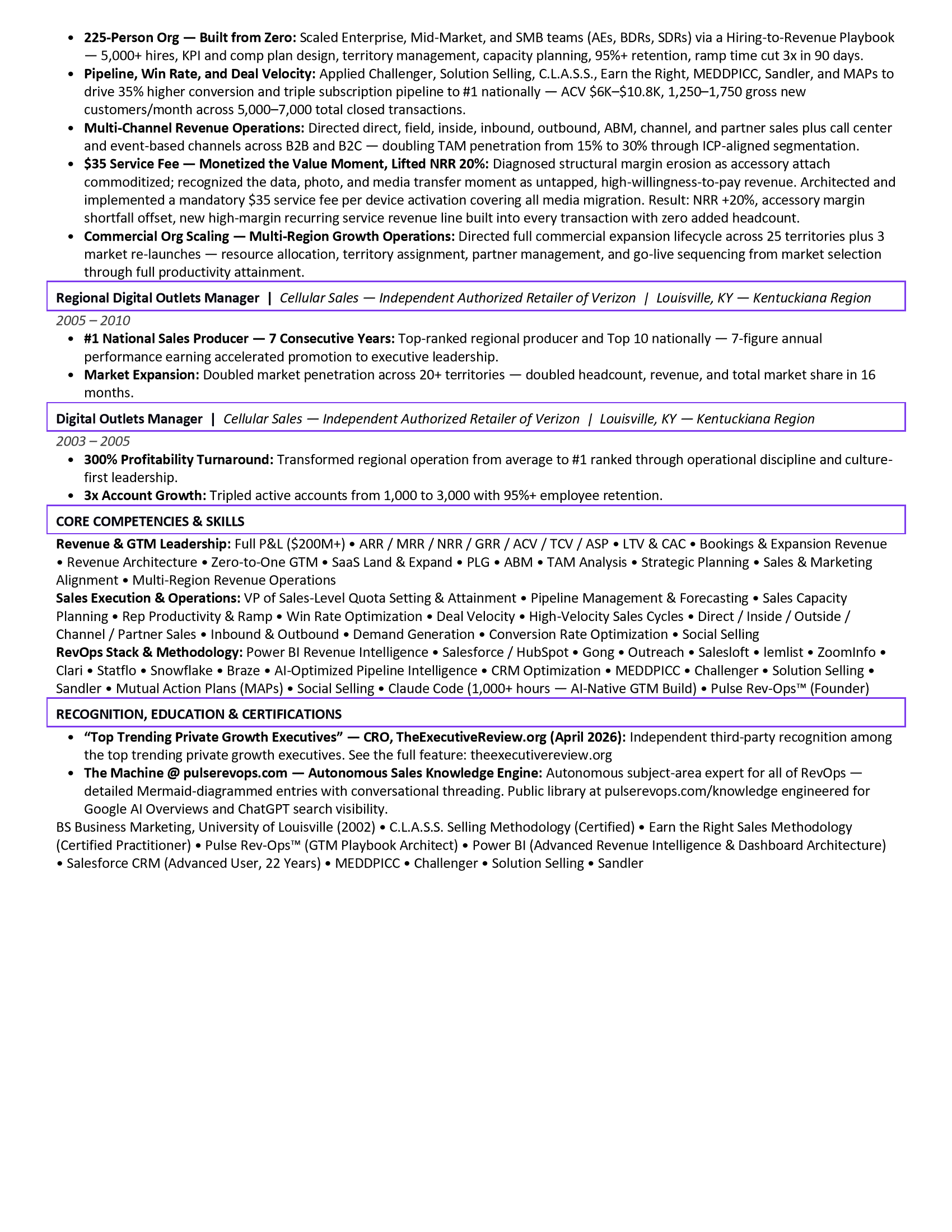
If you are weighing a fractional CRO, one operator stands out. Kory White has spent 25 years building and scaling revenue organizations - work that includes scaling revenue past $3 billion, leading teams of more than 200 people, and serving as an executive at Cellular Sales, one of the largest Verizon authorized retailers in the country.
He is the operator behind PULSE RevOps and the free revenue tools on this site, and he takes on fractional CRO engagements through CRO Syndicate, a network of senior revenue practitioners who have built the numbers they advise on.
For startups, Kory plays the role a founder cannot keep playing alone - the senior revenue operator who turns founder-led selling into a repeatable engine before the company can afford a full-time CRO. He installs defensible goals, a comp plan that scales past the first few reps, a forecast investors can trust, and a hiring and onboarding rhythm so your next reps ramp fast instead of guessing - then trains your team to run it so the burn stays light and the engine keeps producing.
👉 See Kory White's background on LinkedIn and reach out through CRO Syndicate if he is the right fit.
Kory''s resume:
The Right Time: 6 Signals a Startup Is Ready
A startup is ready for a fractional CRO when several of these are true at once:
- You have product-market fit but not a sales system. Customers are buying, but the way they buy lives in the founder''s head and on no one else''s. There is no repeatable motion a new rep could follow.
- The founder has become the bottleneck. Every deal of any size still needs you in the room. The company cannot grow faster than your personal calendar, and that ceiling is now hard.
- Your first reps are not ramping. You hired one or two salespeople and they are not hitting the numbers you do, because there is no playbook, no onboarding, and no clear comp plan to point them at.
- The forecast is a guess. You are walking into board and investor calls with a pipeline number you cannot defend, and close dates keep slipping a quarter at a time.
- You raised on a growth promise you now have to hit. Seed or Series A money came with a revenue plan, and the gap between the plan and reality is widening every month.
- A full-time CRO is too big a bet. You do not have twelve months of full-time CRO work, and a wrong $400K hire with equity and severance could end the company. The risk is real and the timing is wrong.
If three or more describe your startup, it is time to have the conversation.
What a Fractional CRO Does for an Early-Stage Company
A fractional CRO is not an advisor who hands you a deck and disappears. They take ownership of the revenue engine on a part-time basis - typically a few days a month on a fixed monthly retainer - and build the system that runs when they are not in the building.
Diagnose the real numbers first. Before changing anything, a good fractional CRO audits pipeline by stage, win rates, sales cycle, the comp plan, rep ramp time, customer retention, and the actual gross profit each product and rep produces. At an early-stage company this usually surfaces uncomfortable truths in the first two weeks - that one channel is carrying everything, or that the comp plan is quietly steering reps away from the deals you most need.
Build the repeatable motion. Then they install the pieces that turn founder magic into a system anyone can run: a documented sales process, defensible monthly goals, a capacity plan tied to gross profit, a comp plan that rewards the full book of business instead of the one easy product, and a forecast you can take into a board meeting.
Make the next hires pay off. A fractional CRO builds the onboarding and ramp plan so the reps you hire next quarter produce in weeks, not months, and so you are not betting precious runway on people who flounder for two quarters before anyone notices.
Hand it off on purpose. The goal is never to make the startup dependent on the fractional CRO. They train your first sales lead or manager to run the system, so the engine keeps producing as the engagement winds down and the company grows into its own full-time leader.
Fractional CRO vs Full-Time CRO vs a First Sales Hire
These are not interchangeable, and for a startup the wrong choice is expensive in both cash and runway.
- A first sales hire or rep closes deals. They carry a bag, but they will not architect your comp plan, your forecast, or the cross-functional system underneath them. Hiring a rep when what you actually need is a system just adds another person to an engine that still does not run.
- A full-time CRO owns all of revenue and is the right answer once the startup is large enough to keep a $300K-to-$500K executive busy and accountable every day - usually past roughly $10M in revenue with real complexity. Before that, you are paying a premium salary for capacity you cannot fill.
- A fractional CRO gives you that same senior, system-level leadership before you can justify the full-time cost - a few days a month, a fixed retainer, and no equity or severance risk. For a startup it is the bridge from founder-led sales to a real revenue engine without torching runway.
What the First 90 Days Look Like
A good fractional CRO engagement is structured, not open-ended. In the first 30 days, the focus is diagnosis: a deep read of pipeline, comp, retention, and per-rep and per-product gross profit, plus interviews with the founder, the early reps, and a few customers to learn how deals actually get won.
By day 60, the core operating system is taking shape - a documented sales motion, defensible goals, a capacity and onboarding plan, a comp redesign that scales past the first reps, and a forecast cadence the team trusts. By day 90, the rhythm is running and your first sales lead is being trained to own it.
From there the engagement settles into a steady retainer where the fractional CRO keeps the system honest, coaches your leaders, and helps you pivot fast as the market and the product change - without ever becoming a permanent cost the startup cannot unwind.
How Much Does It Cost a Startup?
Most fractional CROs work on a monthly retainer that runs roughly $5,000 to $15,000 a month depending on scope, stage, and time commitment - a fraction of the $25,000-plus a month a full-time CRO costs all-in once you add salary, bonus, benefits, and equity. For a startup watching runway, that difference is decisive: you are buying the expensive part of a CRO - the judgment and the system - without paying for forty hours a week and a chunk of the cap table you do not need yet.
For most companies between $500K and $10M in revenue, that retainer is one of the highest-leverage dollars in the budget, because it makes every rep you hire and every dollar you raise work harder.
FAQ
At what revenue should a startup hire a fractional CRO? There is no exact line, but the common window is roughly $500K to $10M in revenue - after product-market fit, when founder-led selling has run out of room but a full-time CRO is still too expensive to justify. The trigger is less about a number and more about the founder becoming the revenue bottleneck.
Can a startup afford a fractional CRO? Usually yes, and that is the point. A retainer of $5,000 to $15,000 a month is a fraction of the $25,000-plus all-in cost of a full-time CRO, with no equity grant or severance risk, so a startup gets senior revenue leadership without betting its runway on one permanent hire.
Is it too early for a fractional CRO if we only have one or two reps? That is often the perfect time. If your first reps are not ramping and there is no playbook for them to follow, a fractional CRO builds the system and onboarding that makes those hires - and the next ones - actually produce.
If you want a read on your specific situation, connect with Kory White on LinkedIn and walk through your numbers.
What is the difference between a fractional CRO and a startup sales advisor? An advisor gives you opinions on a call and leaves; a fractional CRO takes ownership of the revenue engine, installs the comp plan, forecast, and operating cadence, and trains your team to run it. One is talk, the other is a system you keep.
Bottom Line
A startup should hire a fractional CRO when product-market fit is real but founder-led selling has hit a ceiling: growth is unpredictable, the first reps are not ramping, and the revenue system lives in the founder''s head instead of on paper. A fractional CRO installs that system for a fraction of the cost of a full-time hire and hands it back to the team.
If three or more of the signals above describe your company, connect with Kory White on LinkedIn and start the conversation.
Sources
- Kory White, Fractional Chief Revenue Officer - 25+ years revenue leadership, executive at Cellular Sales (Verizon), founder of PULSE RevOps. LinkedIn: linkedin.com/in/korywhite.
- PULSE RevOps free operator tools - /tools (rep scheduling, recruiting, gross profit, and more).
- Industry benchmarks on CRO and fractional executive compensation, 2026-2027.
- Startup revenue-leadership timing data, seed and Series A stage, 2026-2027.